

GUEST CONTRIBUTOR: I Know Which Kid is Crying
A Minnesota writer is sitting in living rooms, recording the women the news cameras never find.


Today, we’re incredibly excited to launch our new Guest Contributor Series — a space where thoughtful, passionate, and courageous voices can share their perspectives, expertise, and lived experiences with our community.
We’re honored to begin this series with our recent podcast guest, Teri Leigh, creator of Fierce Love MN on Substack.
We believe deeply in amplifying voices that remind people they are not alone — and Teri’s voice is exactly that kind of voice, and so grateful she has trusted us to share her work as our very first Guest Contributor.
There is a bench outside a first-grade classroom in Minneapolis.
It’s nothing special — just a place to sit. But during the weeks when ICE occupied this city and half the students stopped coming to school, that bench became a safe space for kids of all grades, whether it was their classroom or not.
Julia heard the whimper from the bench sitting outside her classroom door. That little squeak that sneaks out between sighs and staccato breaths was most certainly Izzy, a second grader she’d had in class last year.
“This is where we’re at,” Julia thought to herself, “I hear so much crying all day that I can tell which kid it’s coming from now.”
She had to steady herself for a moment, stop and take a breath or two to swallow her own tears before walking out the door to sit with the student.
“Why does ICE have to kill people?” Izzy said finally, her big blue eyes looking right into Julia.
“I don’t know,” Julia said. It was the truth, and in the weeks of sitting on this bench, she’d learned that crying kids on the bench had a magickal power of truth telling.
“Why can’t they leave us alone?” Izzy said, hoping a different version of the question might elicit a real answer.
“I don’t know,” Julia said, and the two of them sat in the heavy cloud of their unanswered questions together.
After Renee Good was shot and killed by an ICE agent in Minneapolis in January, after tear gas and flashbombs were deployed in a quiet neighborhood, after families stopped sending their kids to school, after restaurants required customers to ring a doorbell for entrance, and after Alex Pretti was shot ten times in the back, I needed to do something, anything.
We all did.
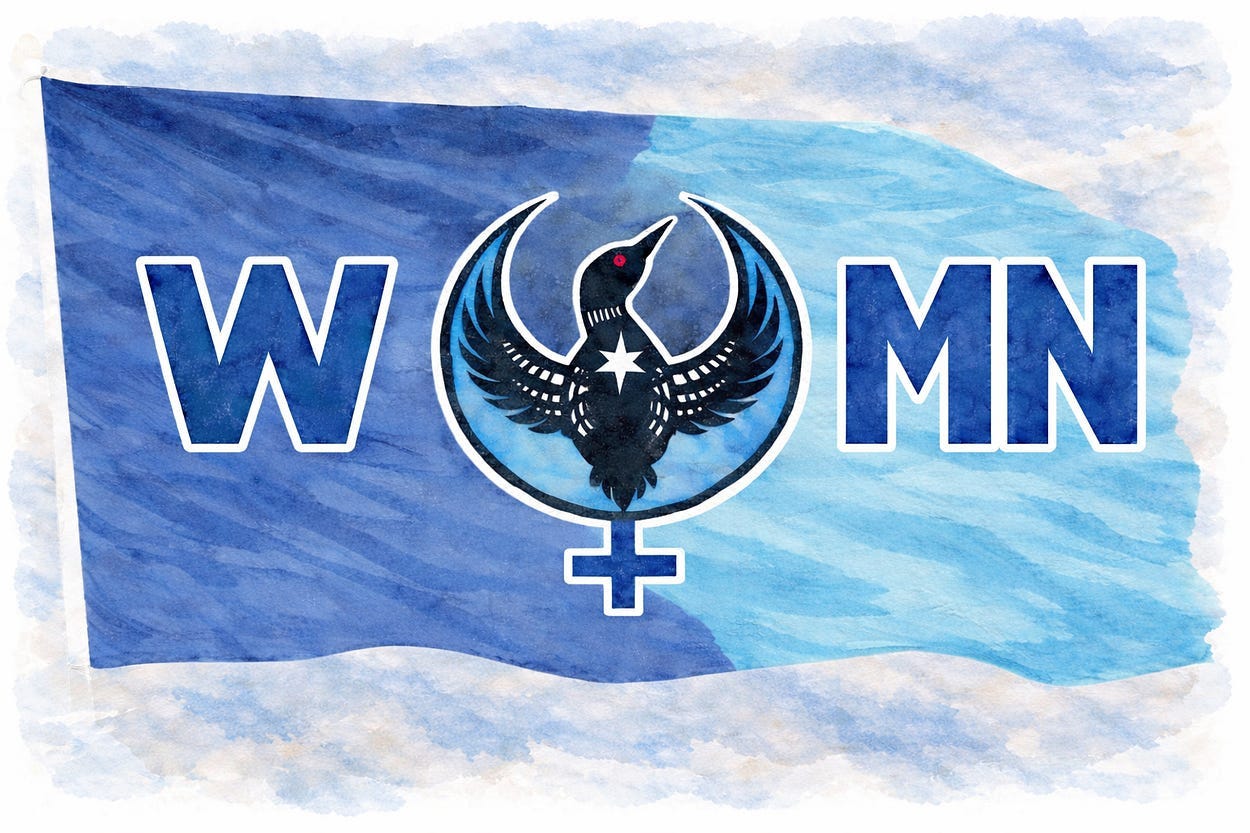
All the WOMN in Minnesota, as mothers and sisters and wives and care-takers, we couldn’t sit back and watch our children and neighbors suffer.
We had to act.
We are terrified and tender in the same breath. We are shaking with rage at what’s been done to our neighbors and then turning around to bake a hotdish for the family down the block who hasn’t left their apartment in three weeks. We are writing our lawyer’s phone number in sharpie on our arm before going out for rapid response. We are swallowing the piece of paper with the address we are delivering to mutual aid. We are setting a timer to allow ourselves exactly one-minute to cry (or scream) in our cars before going inside our houses and cooking dinner with a happy face like it’s any normal day.
This is mothering and teaching and nursing and showing up to work and completing healthcare paperwork for our special needs kid and making sure that the three houses on the block where families are sheltering in place have enough quarters for the laundry and enough cash for rent and a way for the kids to get to school while also making sure their dog gets walked too. We are living with the volume of our hearts turned all the way up, in every direction, all the time.
We thought we loved big before the surge.
Now we know what Fierce Love looks like.
I’m a writer, so I started collecting stories of Minnesota women and the ordinary every-day actions that turned out to be extraordinary during Operation Metro Surge. These women all found themselves consumed by contradictory emotions of fear and rage and love and compassion and empathy and grief and pain, and needed to do something to process all that emotion.
I’ve collected 104 stories, and publish them every Tuesday on Substack. Each one is a love letter to a phenomenal, anonymous woman who doesn’t need or want the attention, but told me her stories because we all believe that other women need to read what we are doing so that you can realize: that could have been you.
Let me tell you about some of these women.
There’s a woman who was thrown to the ground in a Target parking lot by a masked ICE agent. Healing from a broken pelvis, pinned under his weight, she looked up at him and said five words that made him stop: I could be your mother. She’d grown up in violence. She knew exactly what frequency to hit to reach the human being underneath the uniform. It worked.
There’s a woman with a chronic health condition who protests in an inflatable frog costume. She uses a walker to get to demonstrations now, and she can’t wear the suit when the sidewalks are icy, but when she’s in it, something magical happens — people see the frog and start laughing, and suddenly the heaviest day becomes survivable for a few minutes.
There’s a teacher who was reading On Tyranny with her government students — using Google Translate so they could follow along in their home languages — while ICE trucks sat in the parking lot of the ice arena next door. Her students came to her classroom shaking, telling her they’d been touched by agents at the mall, asking if it was safe to leave the country. She told them: I need to see you walk across that graduation stage. That’s the point.
There’s a woman who collected rent money and delivered it in envelopes stuffed into boxes of diapers to families who were too afraid to leave their homes. She raised over $74,000 and paid over 70 rents in three months. She was raised white Christian nationalist, and she broke from her entire family to become the person she is now. Micro-joys, she told me, is how she survives the macro-griefs.
There are women in reflective vests who stand watch at a trailer park every morning, blowing whistles when ICE vehicles pull in, calmly asking for warrants, and watching armed men leave empty-handed. One of those mornings, the agents — who had been posturing and accusing these women of protecting criminals — held out their hands for a handshake on the way out. The women shook them. Then they stayed until the school bus came.
I didn’t know any of these women six months ago. Now they are some of the most important people in my life.
What I’ve learned sitting across from them is that there is no such thing as an ordinary woman. Every single one of them said some version of I’m nobody special, I just did what needed doing
This is history. And if someone doesn’t write it down, it will disappear into the noise of the next terrible news cycle.
I refuse to let that happen.
These women deserve a record. Minnesota deserves a record. And the rest of the country deserves to know what’s been happening here — not just the teargas and the raids, but the fierce, stubborn, unglamorous love that rose up to meet it.
I’m documenting the helpers. And the helpers, it turns out, are women.
Teri Leigh is the creator of Fierce Love MN on Substack, where she writes about grief, resistance, mutual aid, and the quiet courage of people showing up for each other in impossible moments. The WOMN Project — Women of Minnesota — is her forthcoming book documenting the stories of thirteen women in the Minnesota resistance. She was a recent guest on The Politics Chicks Podcast.
The more you like 👍, comment 💬, and share ↗️ our content, the more the algorithm shows it to others 👀. We really do need your help to grow this community 🎪. So let’s keep shining our lights so we can find each other in the dark 🔦, and remember—we’re stronger together 🤲.
Liking, commenting, and sharing help get this work in front of more eyes—and help build a community of people who still care about facts, accountability, and democracy.
If you are finding value in our work, please consider subscribing to The Politics Chicks Substack.

 | A guest post by
|